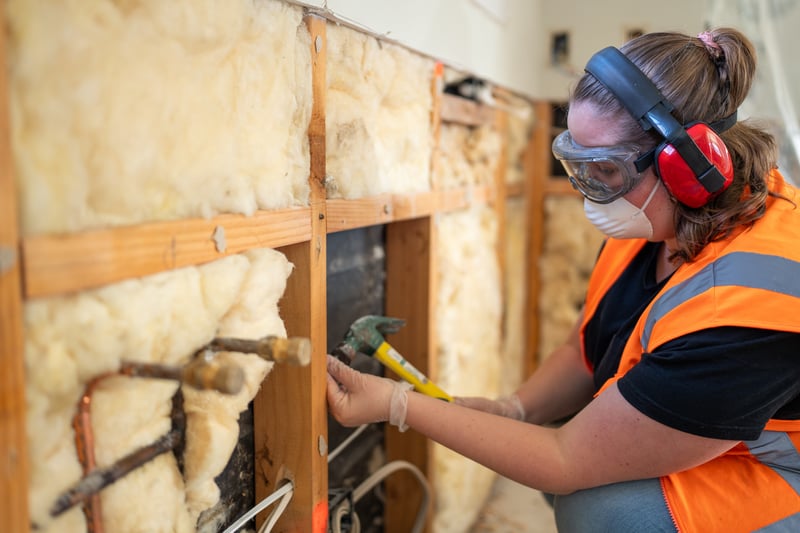
A fixer-upper can look affordable until you start adding up repairs, but an FHA 203(k) renovation loan helps solve that problem.
An FHA 203(k) loan combines your home purchase or refinance and approved renovation costs into one FHA-insured mortgage.
That structure can be useful when a home needs repairs before it fully works for your household, or when you want to update a home without taking out a separate personal loan, credit card balance or second mortgage.
FHA 203(k) Renovation Loan Basics
| Feature |
How It Works |
What It Means For You |
| Loan Purpose |
Purchase, refinance and renovate with one mortgage |
You do not need a separate renovation loan for eligible work |
| Loan Types |
Limited 203(k) and Standard 203(k) |
The right option depends on project size and whether structural work is involved |
| Repair Funds |
Held in escrow after closing |
Contractors are paid as approved work is completed |
| Occupancy |
Primary residence generally required |
You usually cannot use FHA 203(k) for a vacation home or investment-only property |
| Mortgage Insurance |
FHA mortgage insurance applies |
Both upfront and annual mortgage insurance premiums can affect cost |
What Is An FHA 203(k) Renovation Loan?
An FHA 203(k) renovation loan is an FHA-insured mortgage that lets you buy or refinance a home and finance approved repairs or improvements with one loan.
The loan is different from a standard FHA purchase because part of the mortgage proceeds are set aside for rehabilitation work. Instead of giving you all renovation money directly at closing, the lender places repair funds in an escrow account and releases them as work is completed and approved.
The FHA 203(k) program is designed for properties that need rehabilitation. HUD says the program can be used with Standard 203(k) loans for major rehabilitation or repairs and Limited 203(k) loans for less expensive repairs or improvements.
Limited 203(k) vs. Standard 203(k)
FHA offers two main 203(k) options: Limited 203(k) and Standard 203(k). Both can roll approved renovation costs into one mortgage, but they are used for different project types.
| Feature |
Limited 203(k) |
Standard 203(k) |
| Best For |
Smaller, non-structural repairs and updates |
Major rehabilitation, structural repairs or larger projects |
| Repair Cap Or Minimum |
Up to the current FHA Limited 203(k) repair limit |
At least $5,000 in eligible repairs |
| Structural Work |
Generally not allowed |
May be allowed when requirements are met |
| HUD Consultant |
Optional in some cases |
Required |
| Complexity |
Usually simpler |
More documentation, oversight and draw management |
HUD’s 203(k) consumer fact sheet says an FHA-approved 203(k) consultant is required for all Standard 203(k) mortgages and may be used for Limited 203(k) mortgages. It also states that required permits must be obtained before work starts and posted onsite for the work being performed.
What Is A Limited 203(k) Loan?
A Limited 203(k) loan is the FHA 203(k) option for smaller, non-structural repairs and improvements. It can work for updates that do not involve major structural changes.
Examples may include:
- Flooring replacement
- Appliance replacement
- Interior or exterior painting
- Minor kitchen updates
- Minor bathroom updates
- HVAC replacement
- Roof repair or replacement
- Energy-efficiency improvements
- Accessibility improvements
The Limited 203(k) can be easier than the Standard 203(k) because it is meant for less complex work. A HUD consultant is not required in all Limited 203(k) cases, although one may be used when needed.
What Is A Standard 203(k) Loan?
A Standard 203(k) loan is used for larger rehabilitation projects, including work that may involve structural repairs or major remodeling.
A Standard 203(k) may be needed for:
- Foundation repairs
- Structural changes
- Major rehabilitation
- Room additions
- Conversions of existing space
- Repair of significant health or safety issues
- Projects that require more formal oversight
For a Standard 203(k), the lender uses an FHA-approved 203(k) consultant. HUD’s 203(k) process explains that the consultant visits the home, prepares a work write-up and cost estimate, and provides the work write-up and bids to the lender.
FHA 203(k) Eligibility
FHA 203(k) eligibility depends on the borrower, property, renovation scope and loan amount. You need to qualify for the FHA mortgage and the planned work must fit FHA rules.
Occupancy Requirement
FHA 203(k) loans are generally for owner-occupied homes. That means you usually need to live in the property as your primary residence after the loan closes and the home is ready for occupancy.
This makes FHA 203(k) different from a loan used to renovate a pure investment property. If your plan is to renovate a property only to rent it out or resell it, FHA 203(k) financing generally is not the right fit.
Credit Score And Down Payment
FHA’s minimum required down payment is generally 3.5% of the adjusted value when the borrower qualifies for maximum FHA financing.
Lenders may set higher credit score requirements than FHA’s baseline rules. These stricter lender rules are called overlays. If one lender says no, another lender may still review the file differently, but the loan still has to meet FHA requirements.
Debt-To-Income Ratio
Debt-to-income ratio, or DTI, compares your monthly debt payments with gross monthly income before taxes. In plain language, it helps the lender decide whether the mortgage payment fits your budget.
For an FHA 203(k), the lender reviews the full proposed mortgage payment, including principal, interest, property taxes, homeowners insurance, FHA mortgage insurance and any association dues. The lender also reviews your other debts, such as auto loans, credit cards and student loans.
Property Types
FHA 203(k) loans may be used for certain one- to four-unit properties when the property and transaction meet FHA requirements.
HUD lists acceptable property types for the 203(k) program, including single-family homes, one- to four-unit structures that have been completed for at least one year and certain mixed-use properties that meet residential-use requirements.
Loan Limits And After-Improved Value
The final FHA 203(k) mortgage amount must fit FHA rules, including county loan limits and value calculations.
For FHA 203(k), the lender may use the property’s value after improvements are completed to support the renovation loan structure. This is often called the after-improved value. It helps the lender evaluate whether the completed home supports the loan amount.
What Renovations Are Allowed With FHA 203(k)?
FHA 203(k) loans can cover many repairs and improvements that are permanently connected to the property and meet program rules. The work generally must improve the home’s safety, livability, function or value.
| Usually Eligible |
Usually Not Eligible |
| Roof repair or replacement |
Luxury improvements that do not become a permanent part of the property |
| Plumbing repairs |
Swimming pools |
| Electrical repairs |
Hot tubs |
| Heating and cooling systems |
Outdoor fireplaces or barbecue pits |
| Kitchen and bathroom updates |
Detached luxury improvements that do not support basic property use |
| Accessibility improvements |
Repairs that do not meet permit or code requirements |
HUD’s 203(k) consumer materials identify examples of possible improvements, including additions, finished attics and basements, accessibility upgrades, energy conservation improvements, disaster mitigation improvements, roof repair or replacement, and updates to heating, cooling, plumbing and electrical systems.
How FHA 203(k) Renovation Funds Are Paid
FHA 203(k) renovation funds are not usually handed to you in one unrestricted payment at closing. The lender places the rehabilitation funds in escrow and releases them as the work is completed.
An escrow account is a controlled account used to hold money for a specific purpose. For a 203(k), the purpose is paying for approved renovation work.
HUD explains that the 203(k) process includes lender underwriting, closing and funding, with renovation funds placed in escrow and released to the contractor as rehabilitation work is completed.
Step-By-Step FHA 203(k) Loan Process
The 203(k) process has more steps than a standard FHA purchase because the lender has to approve both the mortgage and the renovation plan.
1. Set A Renovation Budget
Start with the work you need done and the amount you can afford. A contractor estimate is more useful than a rough guess because the lender needs documented costs.
Build in a contingency for unexpected repairs. A contingency is extra money set aside for issues discovered after work begins.
2. Choose The Right 203(k) Type
Use the Limited 203(k) for smaller, non-structural work that fits program limits. Use the Standard 203(k) for larger projects, structural repairs or work that requires a HUD consultant.
Choosing the wrong 203(k) type can delay the loan if the project scope changes after underwriting begins.
3. Find An Eligible Property
The property must meet FHA requirements and must be able to support the planned renovation. For a purchase, the home also has to fit the loan limit and occupancy requirements.
If the property has severe damage, zoning issues, unpermitted work or major habitability problems, ask the lender early whether the project can be financed with a 203(k).
4. Get Contractor Bids
Contractor bids should describe the work, materials and cost. Vague bids can slow underwriting because the lender needs enough detail to approve the repair escrow.
Contractors may also need to meet lender requirements for licensing, insurance and experience. FHA 203(k) work generally needs to follow permit and code requirements.
5. Use A HUD Consultant When Required
A HUD-approved 203(k) consultant is required for Standard 203(k) loans. The consultant helps inspect the property, identify required work and prepare documentation for the lender.
HUD’s 203(k) process says the consultant visits the home, prepares a work write-up and cost estimate, and provides the work write-up and bids to the lender.
6. Complete The Appraisal And Underwriting
The lender uses the appraisal and renovation documents to evaluate the property and loan amount. The appraiser may consider the value after approved improvements are completed.
Underwriting is the lender’s review of the borrower, property, renovation plan and loan structure. You may need to provide income documents, asset statements, contractor paperwork and explanations for any issues in the file.
7. Close The Loan And Start Work
After closing, the renovation funds are placed in escrow. Work begins according to the approved scope and timeline.
Do not start work before the lender says it is allowed. Work completed too early may not be reimbursable or may create documentation problems.
8. Complete Inspections And Draws
Contractors are usually paid through draws. A draw is a release of funds from the repair escrow after approved work is completed.
For larger projects, inspections may be required before each draw. Final funds are released after the lender confirms that the work is complete and acceptable.
FHA 203(k) Refinance
An FHA 203(k) refinance lets an existing homeowner refinance and finance eligible renovation costs into a new FHA-insured mortgage.
This can be useful if you already own the home and need a larger renovation than you can comfortably pay for in cash. It may also help avoid using higher-rate credit cards or unsecured personal loans for major repairs.
The same basic tradeoff applies: you are increasing the mortgage balance and using the home as collateral. The new loan should fit your monthly budget after renovations are included.
FHA 203(k) Pros And Cons
An FHA 203(k) loan can make renovation financing more accessible, but it is not the simplest mortgage option.
| Potential Benefit |
Potential Drawback |
| One mortgage can finance the home and approved repairs |
More paperwork than a standard FHA loan |
| May allow a lower down payment than many separate renovation options |
FHA mortgage insurance applies |
| Can help finance repairs on homes that need work |
Contractor bids, permits and inspections can add time |
| Standard 203(k) can support larger renovation scopes |
Standard 203(k) requires a HUD-approved consultant |
| Repair funds are controlled through escrow |
You may not have direct control over when funds are released |
FHA 203(k) vs. Other Renovation Financing Options
A 203(k) loan may be a good fit for FHA-eligible borrowers who want one mortgage for both the home and repairs. Other renovation financing options may work better depending on your equity, credit, project size and whether you already own the home.
| Option |
How It Works |
When It May Fit |
| FHA 203(k) |
One FHA-insured mortgage covers purchase or refinance plus approved repairs |
You want FHA financing and the home needs eligible renovation work |
| Conventional Renovation Loan |
Conventional mortgage structure with renovation funds included |
You qualify conventionally and want a non-FHA renovation option |
| Home Equity Loan |
Lump-sum second mortgage secured by your home equity |
You already own the home and know the project cost |
| HELOC |
Revolving credit line secured by your home equity |
You already own the home and need flexible access for phased projects |
| Personal Loan |
Unsecured loan not tied to the home |
Smaller projects when you do not want to use the home as collateral |
Common FHA 203(k) Mistakes To Avoid
FHA 203(k) loans can be useful, but they require realistic planning. Problems often come from underestimating cost, scope or documentation.
Common mistakes include:
- Choosing a Limited 203(k) when the project needs a Standard 203(k).
- Assuming luxury improvements are allowed.
- Starting work before the lender approves it.
- Using vague contractor bids.
- Forgetting permits or local code requirements.
- Underestimating how long renovation work may take.
- Not budgeting for unexpected repairs.
- Assuming every property can qualify.
When An FHA 203(k) Loan May Make Sense
An FHA 203(k) loan may make sense when the home needs repairs and you want to finance the purchase or refinance and renovation through one mortgage.
It may be worth considering if:
- You plan to live in the home as your primary residence.
- The property needs eligible repairs or improvements.
- You want one mortgage instead of separate home and renovation loans.
- You can qualify for FHA financing.
- You have contractor bids and a realistic renovation budget.
- You are comfortable with escrow, inspections and draw releases.
When An FHA 203(k) Loan May Not Be The Best Fit
An FHA 203(k) loan may not be the best fit if the project is too small, too complex or not allowed under FHA rules.
It may be less practical if:
- You want to buy a pure investment property.
- You want luxury improvements that are not eligible.
- You need full control over renovation funds upfront.
- You do not have qualified contractors.
- The property has issues that cannot be resolved under FHA rules.
- You qualify for a simpler or less expensive financing option.
The Bottom Line
An FHA 203(k) renovation loan lets you buy or refinance a home and finance eligible repairs with one FHA-insured mortgage. It can be useful when a property needs work but you want to avoid separate financing for the renovation.
The main choice is between Limited 203(k) and Standard 203(k).
Limited 203(k) is generally for smaller, non-structural improvements. Standard 203(k) is for larger or structural projects and requires a HUD-approved consultant. Before choosing this loan, make sure the property, renovation scope, contractor bids and timeline all fit FHA requirements.
Frequently Asked Questions
What Is An FHA 203(k) Renovation Loan?
An FHA 203(k) renovation loan is an FHA-insured mortgage that lets you buy or refinance a home and finance approved repairs or improvements with one loan. Repair funds are held in escrow and released as work is completed.
What Is The Difference Between Limited 203(k) And Standard 203(k)?
Limited 203(k) is generally for smaller, non-structural repairs. Standard 203(k) is for major rehabilitation, structural repairs or larger projects. A HUD-approved 203(k) consultant is required for Standard 203(k) loans and may be used for Limited 203(k) loans.
What Is The Minimum Down Payment For An FHA 203(k) Loan?
For FHA loans, the minimum required investment is generally at least 3.5% of the adjusted value when the borrower qualifies for maximum financing. HUD explains that FHA requires at least 3.5% of adjusted value for the maximum mortgage amount.
What Repairs Can An FHA 203(k) Loan Cover?
An FHA 203(k) loan can cover many eligible repairs and improvements, such as roof work, plumbing, electrical systems, heating and cooling, kitchen and bathroom updates, accessibility improvements, energy conservation improvements and certain additions. The work must meet FHA, lender, permit and code requirements.
Can I Use An FHA 203(k) Loan For A Pool?
Generally, no. FHA 203(k) funds are not meant for luxury improvements such as swimming pools, hot tubs or similar amenities.
Do I Need A HUD Consultant For An FHA 203(k) Loan?
You need a HUD-approved 203(k) consultant for a Standard 203(k) loan. A consultant is not required in every Limited 203(k) case, but one may be used when needed.
Can I Do The Renovation Work Myself?
Generally, FHA 203(k) renovation work should be completed by qualified contractors who meet lender and program requirements. Ask the lender before assuming any do-it-yourself work is allowed.
Can I Use An FHA 203(k) Loan To Refinance And Renovate?
Yes. FHA 203(k) loans can be used for an eligible refinance and renovation when the borrower, property, renovation scope and loan amount meet FHA requirements.




.jpg?quality=80&width=150)